If You’ve Tried Everything and Your Students Still Refuse to Listen- Read This
If you feel like a broken record—repeating yourself over and over while your students won’t listen—teacher friend, this one’s for you. There are days (or weeks 😅) when it feels like nothing is working, and you start wondering if your words have just become background noise.
The good news? There is a way to reset the room without yelling, threatening, or starting an entirely new behavior system. I call it my 4-Step Behavior Reset, and it’s designed to help students pause, refocus, and get back on track—especially when listening has completely fallen apart.
Let’s talk about when this happens and exactly how to use this reset effectively.
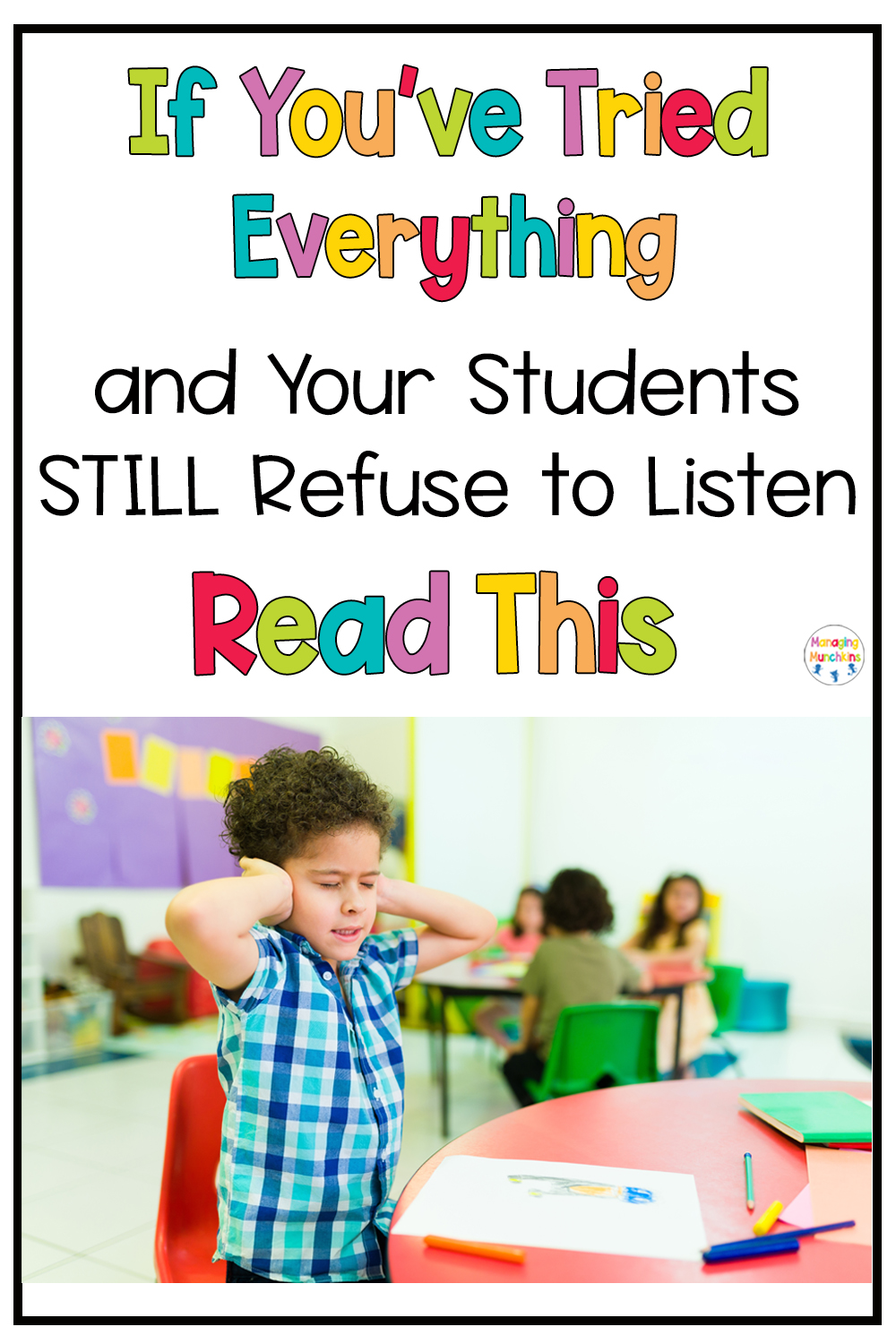
Why Students Won’t Listen (And Why It’s Not Your Fault)
First, let’s normalize this: struggling with listening does not mean you’re a bad teacher.
I’ve seen moments when students won’t listen pop up in so many different situations:
- You get that class that just struggles overall
- A handful of students derail the rest of the group
- Your students are simply immature and still learning basic listening skills
- The time of year works against you (hello, holidays and sugar overload 🎄)
- It’s the end of the year and students feel like the rules no longer apply
Sound familiar? Same. After experiencing this more times than I can count, I created a simple but powerful four-step listening behavior reset that you can pull out when things start to spiral.
The 4-Step Behavior Reset When Students Won’t Listen
This reset is not something you use every day. Think of it as something you keep in your back pocket for those moments when your usual strategies just aren’t cutting it.
Step 1: The Hard Reset
Stop. Everything.
Whether you’re in the middle of a whole-group lesson, centers, or transitions—pause it all.
Use a low, calm voice (this is key). A quiet voice naturally pulls students in and helps calm their bodies. I also recommend:
- Making intentional eye contact
- Slowing down your words
- Letting your seriousness set the tone
You might say something like:
“Boys and girls… we need to stop and have a chat.”
That moment of pause is powerful.
Step 2: The Calm Chat
This is not a lecture. This is a calm, clear conversation.
Name what you’re seeing and why it’s not okay:
- “I’m feeling really sad right now.”
- “We are not following rule number two—following directions quickly.”
- “I saw students running, talking, and not listening.”
Be specific, calm, and matter-of-fact. No shaming. No raised voices. Just clarity.
Step 3: The Rules Refresher
Now it’s time to go back to the basics.
Have students stand up and review the classroom rules together, chorally. This works especially well when students already know the rules by heart.
For example:
- “Rule number one?” → Raise your hand to talk.
- “Rule number two?” → Follow directions quickly.
This step helps students reconnect with expectations and reminds them that the rules haven’t changed—even if the energy in the room has.
Step 4: Watch and Reward (The Most Important Step)
This step is where the magic happens.
Instead of ending on a negative, you end on hope and opportunity.
You might say:
“I really wanted to give you a cookie in the cookie jar today, but I can’t because we weren’t listening. That makes me sad.”
Then immediately pivot:
“Now I’m going to be watching, my friends. When I see you following directions and making better choices, I will put a cookie in the jar.”
This gives students a second chance and a clear path forward.
✨ Important: You must follow through.
If you say you’re watching for positive behavior and they do it, acknowledge it immediately. Make it a big deal. If we don’t follow through, our words lose meaning—and students stop believing us.
Quick Recap: The 4 Steps Reset when Students Won’t Listen
- Hard Reset – Stop everything, lower your voice, make eye contact
- Calm Chat – Clearly state what you saw and why it’s not okay
- Rules Refresher – Review expectations together
- Watch and Reward – End on a positive and follow through
A Final Tip
This reset works best when it’s used sparingly. If you do it every single day, it loses its power and becomes white noise. Try your other strategies first, and use this when you really need to nip behavior in the bud.
Teacher friend, the next time your students absolutely refuse to listen and you’re having one of those days, pull this four-step reset out of your back pocket—and watch behavior start to shift.
You’ve got this. 💛
Until next time, happy teaching!
P.S. Want to make sure you’re not accidentally making behavior worse?
👉 Watch my video: 3 behavior management mistakes that show up in almost every classroom.